Broken Radif, Unbroken Spirit: What Happens When TikTok Reimagines the Ghazal
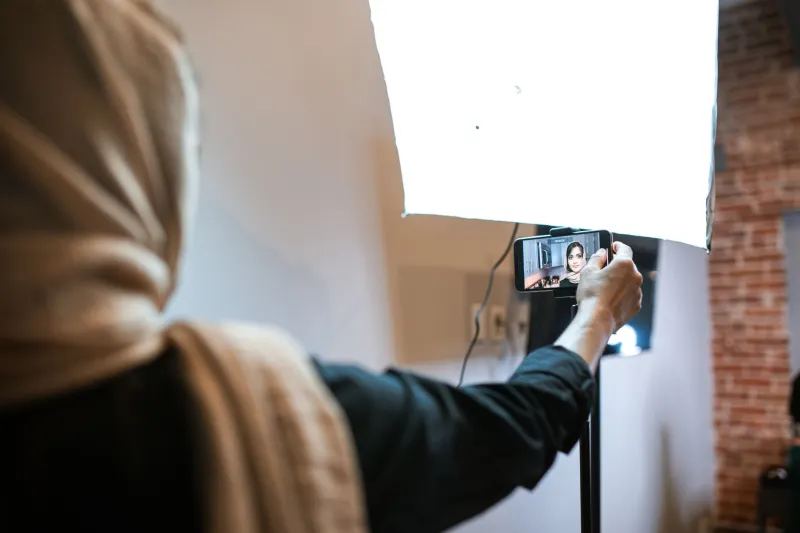
Scroll far enough through the Arabic poetry corners of TikTok and you will eventually encounter a video that stops you mid-swipe. A young woman in a Chicago apartment, ring light glowing, reads a poem she has labeled a ghazal. The refrain does not repeat with structural precision. The maqta — the closing couplet in which the poet traditionally names herself — is missing entirely. The meter is loose, more spoken word than classical prosody.
And yet something in the poem moves. Something in it feels, unmistakably, like the form it is approximating.
This is the central tension animating a growing conversation in Arab-American literary circles: as the ghazal travels into the feeds and comment sections of a new generation, what is gained and what, if anything, is genuinely lost?
A Form With a Long Memory
To understand the stakes of the debate, it helps to know what the ghazal actually is — and how far it has already traveled from its origins.
The ghazal is among the oldest and most formally demanding structures in the Arabic poetic tradition. Its defining features include a strict refrain called the radif, a rhyme scheme that precedes it known as the qafia, an independence between couplets that distinguishes it from narrative verse, and the closing self-address of the maqta. It traveled from Arabic into Persian, from Persian into Urdu, from Urdu into the colonial and postcolonial literary imagination, and from there into English-language poetry through translators and practitioners ranging from Agha Shahid Ali to Galway Kinnell.
By the time the ghazal arrived in American poetry MFA programs, it had already undergone centuries of productive mutation. The English-language ghazal that Ali championed in the 1990s was itself a translation of a translation — a form that had absorbed multiple literary cultures without losing its essential character.
The TikTok ghazal is simply the latest leg of that journey.
What the Algorithm Hears
The social media environment introduces constraints and possibilities that classical prosody never anticipated. A TikTok video runs between fifteen seconds and ten minutes, but the sweet spot for poetry content — based on engagement data that creators in this space discuss openly — sits somewhere between sixty and ninety seconds. That is not enough time for a traditionally structured ghazal of seven or more couplets.
Young poets adapt accordingly. They compress. They drop the maqta because naming yourself in the third person reads as strange to an audience unfamiliar with the convention. They loosen the radif because a rigid refrain can feel, in the spoken-word register that dominates short-form video, more like a verbal tic than a structural anchor.
What remains, often, is the emotional architecture of the form — the sense of autonomous yet thematically linked images, the lyric intensity, the feeling of circling a single longing from multiple angles without ever resolving it. That architecture is recognizable to anyone who has read the classical masters, even when the technical scaffolding has been partially dismantled.
"The kids on TikTok are writing ghazals the way the early Andalusian poets wrote muwashshah — they heard something in the tradition and they made it fit their moment," observed one Arab-American poet and educator based in New York who has been watching the trend with genuine curiosity rather than alarm. "That is not corruption. That is how forms survive."
The Purist's Objection
Not everyone shares that equanimity. Among formally trained poets and scholars of Arabic literature, the TikTok ghazal provokes a range of responses from gentle concern to outright frustration.
The core objection is not snobbery, or at least not only snobbery. It is a legitimate worry about the erasure of the form's internal logic. The ghazal's couplet independence, for instance, is not an arbitrary rule — it encodes a specific philosophy of poetic fragmentation, a deliberate resistance to narrative continuity that reflects something meaningful about how the tradition understands desire and loss. When that independence collapses into a poem that simply flows like free verse with a repeated line, something philosophically significant has been lost, not just a technical feature.
Similarly, the maqta is not decorative. The poet's self-naming in the closing couplet is an act of accountability — a signature in the oldest sense, the maker claiming the made thing. Its disappearance from social media versions of the form quietly removes that dimension of authorial responsibility.
These are real losses, and they deserve acknowledgment.
And Yet Something New Is Being Made
The more interesting question, however, may not be what the TikTok ghazal loses but what it creates. Several poets working at the intersection of digital culture and classical form have begun writing hybrid work that takes the social media misreading as its explicit subject — poems that are formally correct by classical standards but that embed, within their structure, an awareness of how the form sounds to ears that first encountered it through a phone screen.
This reflexive layer adds a dimension that neither the purely classical ghazal nor the purely digital one could achieve independently.
There is also the matter of audience. The classical ghazal, in its English-language form, has largely circulated within MFA programs, literary journals, and the relatively small world of formally attentive poetry readers. The TikTok ghazal, however impure, has introduced the form — its name, its emotional register, its cultural origin — to millions of young Arab-Americans and Arab diaspora viewers who had no prior contact with it.
That is not a trivial accomplishment. Introduction precedes appreciation. The young viewer who hears the word ghazal for the first time in a TikTok comment section and then searches for its history is traveling a path that would not have opened without the imperfect version that caught her attention.
The Tradition as Living Conversation
The Arabic poetic tradition has never been a museum. It has always been a conversation — argumentative, competitive, formally rigorous, and simultaneously alive to the pressures of new contexts. The poets of the Abbasid court debated meter with the same intensity that contemporary critics debate social media adaptation. The Mahjar poets were accused, by their contemporaries, of corrupting classical form by writing in free verse influenced by Western Romanticism.
Those Mahjar experiments are now taught as canonical contributions to modern Arabic literature.
It would be premature, and probably mistaken, to dismiss the TikTok ghazal as the final word on where the form is heading. What it represents, more accurately, is a point of entry — a moment of contact between a tradition with centuries of accumulated depth and a generation that is, in its own halting and enthusiastic way, reaching toward that depth.
The reaching matters. Even when the grip is imperfect.