The Machine Flattens the Qasida: Arab-American Poets Probe AI Translation in 2026
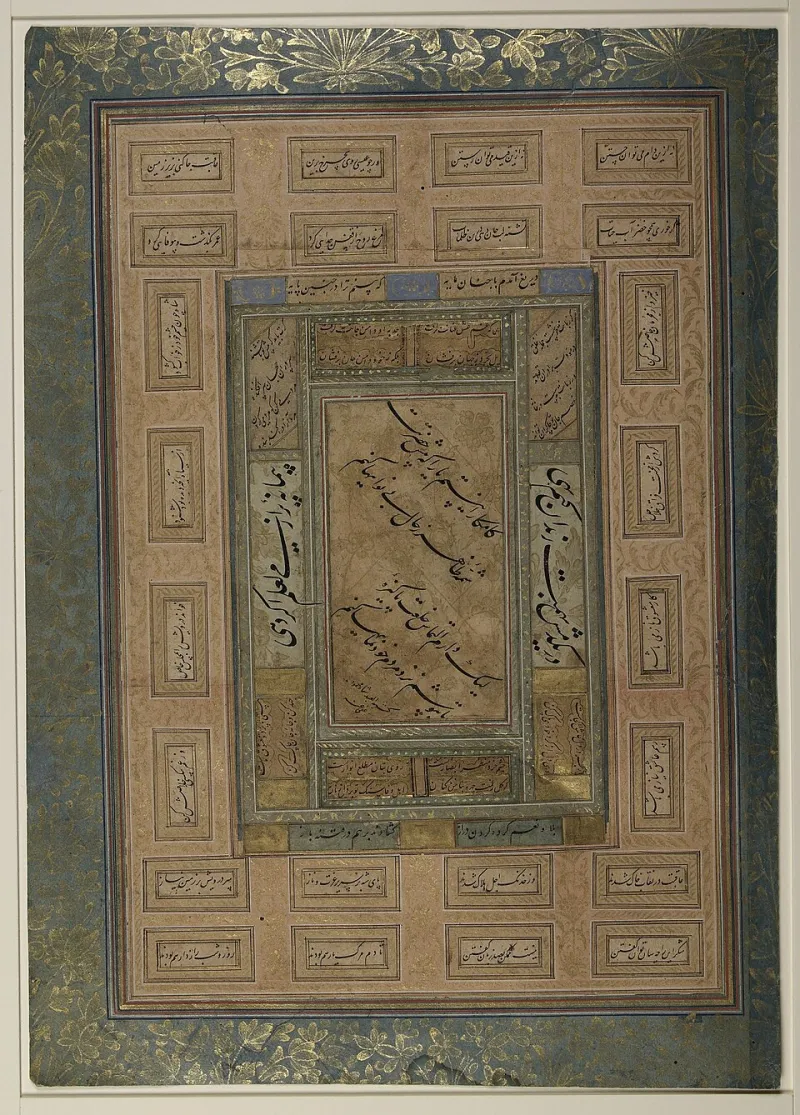
Photo: Shah Mahmud Nishapuri, CC0, via Wikimedia Commons
On a Tuesday evening in Brooklyn this fall, a small group of Arab-American poets opened their laptops and did something that would have seemed eccentric a decade ago: they fed lines of classical Arabic verse into three different AI translation tools and read the results aloud. The room was not hostile to the technology. No one was there to declare the machine a fraud. They were there to watch it fail in interesting ways—and to ask what those failures reveal about the parts of diaspora experience that resist transfer.
A Test, Not a Verdict
The exercise, repeated in living rooms and university classrooms across the United States in 2026, is less a referendum on artificial intelligence than a study in limits. Poets submit a line from Imru' al-Qais, a verse from al-Mutanabbi, a passage from Mahmoud Darwish, or a poem written last week in Detroit or Dearborn. The tools return clean English: subject, verb, image, punctuation. The sentences are often grammatically impeccable. They are also frequently hollow.
A machine rendering of the famous opening of the Mu'allaqa—qifā nabki—might produce 'Stop, let us weep.' That is accurate enough as gloss. It is also a shrug. The Arabic carries a whole architecture of address, ritual, and sound. The English carries information. Poets in the room described the difference as the gap between a photograph of a house and the memory of living in it.
This is not an argument against using AI. Several of the poets admitted they use these tools for rough draft translations, for checking idioms, for generating alternate phrasings when they are stuck. The test is useful precisely because the technology is useful. What interests them is the pattern of what gets lost first.
The Meter That Disappears
Arabic poetry is not merely a container for meaning. It is a sonic system. The qasida, the ghazal, the free-verse poem—each carries expectations of rhythm, rhyme, and cadence that English does not naturally reproduce. When an AI tool translates Arabic verse, it tends to preserve semantic content and discard prosodic architecture. The result can read like a summary of a poem rather than a poem.
One poet in the group compared it to translating a piece of music by describing the instruments. The machine can tell you there is a lute, a drum, a voice. It cannot make you hear the maqam. Human translators face the same problem, of course. But human translators make choices—sometimes sacrificing literal meaning for cadence, sometimes adding a note, sometimes leaving a word untranslated because the English would be a lie. The machine, by contrast, defaults to fluency. It wants to sound natural. That desire for smoothness is exactly what flattens the verse.
The problem is especially acute with contemporary diaspora poetry, where meter may be broken deliberately, where a line may switch between Arabic and English, where a broken rhythm is the point. The machine reads experimentation as error and corrects it. It tidies the poem into something more conventional than the poet intended.
Metaphor as Culture, Not Ornament
AI translation tools handle metaphor reasonably well when the metaphor is portable. A rose is a rose. A journey is a journey. But Arabic poetry is full of images that are not decorative. They are social contracts. The beloved's house is not just a building. The night is not just darkness. Hospitality, honor, exile, and grief are carried in images that assume a shared world.
When a machine translates a line about a grandmother's kitchen, it may render the objects correctly—the coffee pot, the bread, the small glass—and still miss the emotional grammar. In diaspora poetry, the kitchen is often a site of transmission and loss. The machine sees a room. The reader who has lived inside that room sees a whole history of departure.
One of the most telling failures involved names. A poem addressed to a transliterated aunt—her name spelled one way in the poem, another way in the author bio—came back with the name normalized into a more familiar English form. The machine was being helpful. It was also erasing a choice. For Arab-American poets, the spelling of a name is rarely accidental. It can signal region, religion, family preference, or a deliberate refusal of the way American institutions have historically flattened Arabic.
What the Failures Reveal
The poets involved in these tests are not technophobes. They are readers of their own work in translation, and they know that human translators also fail. The difference is that human failure is accountable. A translator can be asked why she chose 'stop' instead of 'halt,' why she kept a diacritic, why she left a word in Arabic. The machine cannot explain its choices in the same way. It can only produce another version.
That is why the tests have become a kind of diagnostic. By watching what the machine cannot hold, poets are mapping the untranslatable parts of diaspora experience: the way a language carries shame and pride at once, the way a poem can be addressed to a homeland that no longer exists, the way a single Arabic word can open a door that English keeps closed.
The results are often awkward. They are also instructive. In 2026, the question is no longer whether AI can translate Arabic poetry. It can, in the narrow sense of producing English sentences. The better question is what happens when a community reads those sentences and recognizes the shape of what is missing. That recognition is not a rejection of technology. It is a defense of the poem as a living form—one that can survive the machine only if someone is willing to hear what the machine cannot say.