Scrolling Through the Diwan: How TikTok Became the Unexpected Home of Arabic Verse
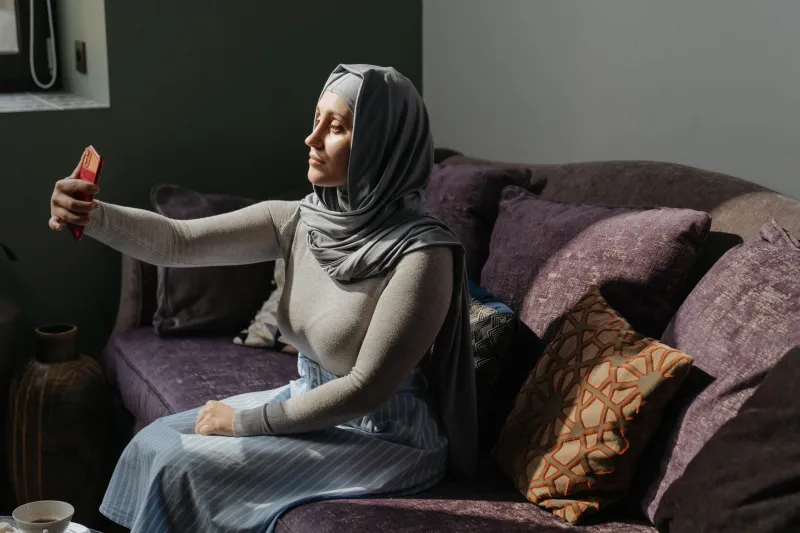
There is a moment that has played out thousands of times across living rooms in Dearborn, Michigan, in Houston's Westheimer corridor, and in the Arab neighborhoods of Brooklyn, New York. A teenager holds a phone to her face, recites a line of classical Arabic verse — perhaps from al-Mutanabbi, perhaps from Nizar Qabbani — and a grandmother seated somewhere nearby looks up from her tea with something between surprise and recognition. The poem is old. The delivery is new. The connection, however, is timeless.
This is the quiet revolution happening inside TikTok's Arabic poetry community, a corner of the platform that has grown from a niche curiosity into a genuine cultural force, drawing millions of views and, more significantly, drawing diaspora youth back toward a literary inheritance many feared was slipping away.
The Algorithm Did Not Expect This
When TikTok's recommendation engine was designed, it was optimized for virality — dance challenges, comedic sketches, life hacks. Nobody engineered it to carry the weight of a thousand-year literary tradition. And yet, that is precisely what has happened.
Creators posting Arabic poetry recitations are regularly reaching audiences in the hundreds of thousands. Videos featuring the measured, musical cadence of classical qasida — the formal ode structure that dominated Arabic poetry for centuries — appear alongside tutorials and trending audio clips, and they hold their own. The comment sections beneath these videos tell a story that no algorithm could have predicted: young Arab Americans writing in a mixture of Arabic and English, asking for translations, sharing the lines with parents, or simply typing a single word — حسيت — "I felt it."
The phenomenon is not accidental. It reflects a generation that grew up bilingual but often formally educated only in English, carrying Arabic as a household language rather than a literary one. For many, poetry is the bridge.
Reclamation, Not Nostalgia
It would be a mistake to read this movement as mere nostalgia. The creators driving it are not simply preserving the past; they are actively reinterpreting it.
Consider the approach taken by a growing number of Arabic-language creators who pair classical verses with contemporary commentary — explaining a line by Ibn al-Rumi through the lens of modern heartbreak, or connecting Darwish's meditations on exile to the lived experience of second-generation immigrants navigating identity in American cities. The classical text becomes a lens through which to examine the present.
This interpretive layer is crucial. It signals that these young creators understand the poems not as museum artifacts but as living documents. The diwan — the collected works of a poet, a word that also denotes a gathering place — is functioning once again as a communal space, only now it exists in a feed rather than a courtyard.
Linguists and literary scholars who study Arabic diaspora communities have noted that this kind of organic, peer-driven engagement with classical texts is extraordinarily difficult to manufacture through formal education. What TikTok has done, perhaps inadvertently, is create the social incentive structure that formal language classrooms often cannot: the desire to share something beautiful with people who matter to you.
Language as Identity, Frame by Frame
For Arab Americans in particular, the relationship with Arabic is complex. Many grew up hearing the language at home but reading and writing almost exclusively in English. Formal Arabic — the fusha of classical poetry — can feel distant even to native speakers of colloquial dialects. The gap between spoken Levantine Arabic and the language of Mutanabbi is, in some respects, as wide as the gap between contemporary English and Chaucer.
And yet, something about the short-form video format seems to close that distance. A thirty-second recitation, delivered with confidence and subtitled in both Arabic and English, strips away the intimidation of the classical register. Viewers encounter the language at human scale. They hear its music before they are asked to decode its grammar.
This is not a trivial point. The musicality of classical Arabic poetry — its intricate meters, its internal rhyme schemes, the way a single root word can branch into a cascade of meanings — is something that scholars spend careers studying. TikTok is not a substitute for that scholarship. But it is a doorway, and for a generation that might never have opened the door otherwise, the doorway matters enormously.
What Gets Lost, and What Gets Found
Not every Arabic poetry TikTok is a work of literary criticism, and the platform's format introduces its own distortions. A poem extracted from its context, reduced to a single striking couplet, can be misread or stripped of its complexity. The danger of the viral couplet is the same danger that exists when any great work is reduced to a quotable fragment: the part is mistaken for the whole.
Creators who are doing this work most thoughtfully seem aware of the tension. Many use multi-part videos to explore a single poem across several installments, building context gradually. Others direct their followers toward full texts, toward translations, toward the broader body of a poet's work. The platform's own architecture — designed for brevity — is being gently pushed against by creators who understand that the poems deserve more than fifteen seconds.
What is being found, in the meantime, is something that formal cultural institutions have struggled to deliver: a sense among young Arab Americans that their literary heritage is not a burden of obligation but a source of genuine pride and beauty. When a line of Qabbani goes viral among teenagers in Chicago, it is not because a school curriculum mandated it. It is because something in the language reached across centuries and felt, as that comment section so simply put it, felt.
الشاعر Reflects
At Al-Shaer, we have always believed that Arabic poetry speaks to something fundamental in human experience — that its forms and its philosophies are not the exclusive property of any single generation or geography. What TikTok's Arabic poetry community demonstrates is that this belief is not merely an editorial position. It is something that young people are discovering for themselves, in their own language, on their own terms.
The shaer — the poet — has always been a figure who speaks across time. It appears that, in 2024, the poet's voice is finding its way through a phone screen and into the ears of a generation that needed to hear it.
The diwan is open. The gathering has begun.