Lost in the Feed: The Invisible Walls Keeping Arabic Poetry Off Your For You Page
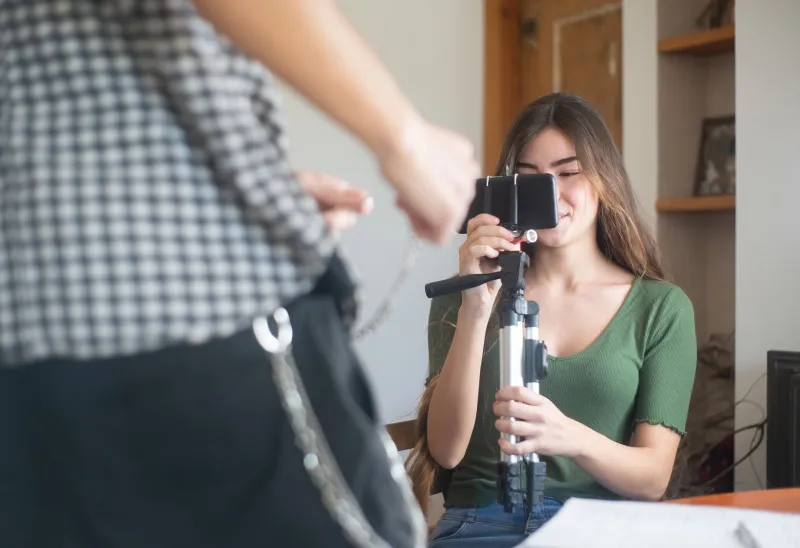
The video has everything a viral moment is supposed to have: a striking visual, a compelling voice, a line of poetry so precise it feels like a small wound. The creator, a twenty-six-year-old poet based in Los Angeles, spent two hours editing it. She posted it on a Tuesday evening, tagged it carefully, and waited. By the following morning, it had accumulated a few hundred views—a fraction of what comparable English-language content routinely achieves. The poem was by Nizar Qabbani. The language was Arabic. And according to her own analysis, the algorithm had essentially declined to distribute it.
"It's not that the content isn't good," she says, speaking on the condition that only her first name, Yasmine, be used. "It's that the system doesn't know what to do with it. Or maybe it does know—and has decided it isn't worth the effort."
This experience is common enough among Arab and Arab-American content creators that it has become a recurring subject of conversation in online communities, at digital media panels, and in the growing body of research examining platform bias. Arabic poetry, despite a demonstrably engaged global audience and a tradition of oral performance that would seem tailor-made for short-form video, consistently struggles to achieve the algorithmic momentum that transforms niche content into cultural conversation.
The Technical Landscape
Understanding why requires a brief look at how recommendation systems actually function. Platforms like TikTok and Instagram Reels rely on a cascade of signals to determine which content to amplify: watch time, completion rates, share behavior, comment velocity, and—critically—the accuracy of content categorization. That last factor is where Arabic-language content frequently encounters its first obstacle.
Automatic speech recognition and natural language processing tools, which platforms use to transcribe, categorize, and moderate content, perform significantly less accurately in Arabic than in English. Arabic's morphological complexity, its multiple dialects, and the frequent code-switching between Modern Standard Arabic and colloquial forms all degrade the performance of systems trained predominantly on English-language data. When a platform cannot accurately categorize content, it distributes it more conservatively, limiting its initial reach and therefore its ability to accumulate the early engagement signals that trigger broader amplification.
Dr. Sana Haddad, a digital media researcher whose work focuses on algorithmic equity and non-Western language content, describes this as a compounding problem. "The algorithm is not neutral," she says. "It reflects the training data and the commercial priorities of the companies that built it. Arabic has roughly 400 million native speakers globally, but it has not been treated as a primary market by most major platforms. The result is infrastructure that works less well for Arabic content at every level—transcription, moderation, recommendation."
Creators have documented this disparity through informal experimentation. Several report that posting identical content with English captions versus Arabic captions produces measurably different reach outcomes. Others have found that adding English-language hooks—even brief ones—at the opening of a video can significantly improve distribution, suggesting that the algorithm is weighting language accessibility in ways that disadvantage non-English creators.
The Authenticity Dilemma
This creates a dilemma that cuts to the heart of what these creators are trying to do. Arabic poetry is not simply content that happens to be in Arabic; the language is inseparable from the art form. The sound of the words, the weight of the classical vocabulary, the musicality of the meter—these are not stylistic choices that can be substituted without loss. Yet the platforms are, in effect, rewarding creators who dilute or translate their work.
"I feel like I am constantly being asked to choose between my audience and my integrity," says Kareem Mansour, a spoken word artist and content creator based in Brooklyn who has been building an audience on Instagram for the past four years. "If I subtitle everything in English and lead with an English hook, I reach more people. But I also change the nature of what I'm offering. I start performing for the algorithm instead of for the poem."
Mansour's follower count—approximately 40,000, built over years of consistent posting—reflects what researchers describe as the slower, steeper growth curve that Arabic creators typically experience compared to English-language counterparts producing content of equivalent quality. He is meticulous about his analytics. "I can see exactly where the drop-off happens," he says. "Non-Arabic speakers scroll past within the first two seconds. The algorithm reads that as rejection. It doesn't know they scrolled past because they don't speak the language—not because the content is bad."
What Creators Are Building Instead
Rather than waiting for platforms to address these structural inequities, a growing number of Arabic poetry creators are developing formats specifically engineered to navigate them. The approaches are varied and often ingenious.
Animated verse has emerged as one of the more successful strategies. By pairing classical or modern Arabic poetry with motion graphics that visualize the meaning—abstract forms responding to rhythm, calligraphy that animates in sync with the spoken word—creators give non-Arabic-speaking viewers a visual entry point that sustains watch time even when the language is inaccessible. Higher watch time signals to the algorithm that the content is engaging, improving its distribution prospects regardless of language.
Beat poetry fusion, which layers Arabic verse over contemporary musical production, has found particular traction among younger audiences. The musical frame provides a familiar context that lowers the barrier to engagement, while the poetry itself remains linguistically intact. Several creators working in this format have achieved genuine crossover success, with videos accumulating millions of views across platforms.
Multilingual hooks—brief English or Spanish phrases at the opening of a video, followed by a pivot into Arabic—represent a more pragmatic compromise. Critics within the community argue that this approach capitulates to the algorithm's biases; proponents counter that reaching a wider audience is itself a form of cultural advocacy.
"I think about it as translation in the broadest sense," says Dina Khalaf, a Los Angeles-based creator who specializes in multilingual poetry content. "I am not translating the poem. I am translating the context—giving people enough of an entry point that they will stay and encounter the Arabic itself. If they stay for the music and leave having heard Darwish, that is a victory."
The Longer Horizon
Researchers and creators alike are cautious about optimism, but not without it. Platform companies have, under sustained pressure from advocacy organizations and academic researchers, begun to invest in improved Arabic-language natural language processing. TikTok in particular has made public commitments to expanding its non-English content infrastructure, though creators report that tangible improvements remain uneven.
More significantly, the audience for Arabic poetry in the United States is growing—driven by diaspora communities, by academic interest, and by the broader cultural visibility that the poetry has gained through its presence in protest movements and literary spaces. As that audience grows, the commercial logic of ignoring it weakens.
For Yasmine, the poet in Los Angeles whose Qabbani video failed to find its audience, the response has been to keep posting—and to become more deliberate about format without abandoning the work itself. "The poem is not the problem," she says. "The poem has survived for decades. It will outlast the algorithm. My job is just to help it find its people while the algorithm figures itself out."