Verses on the Barricades: How Classical Arabic Poetry Became a Language of American Protest
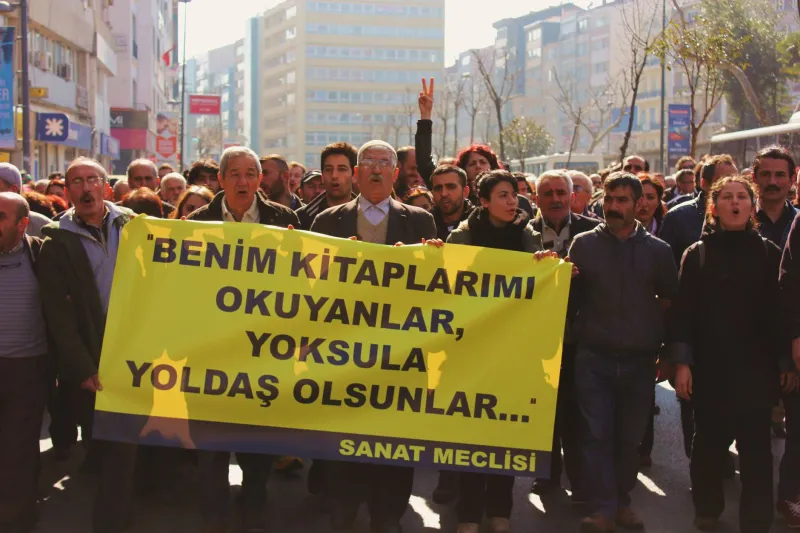
On a cold Saturday afternoon in Dearborn, Michigan, a crowd of several hundred gathered beneath hand-painted banners and the low hum of a portable speaker system. Before the march began, a young woman stepped forward and recited, in Arabic and then in English, lines from Mahmoud Darwish: "On this earth is what makes life worth living." The crowd fell momentarily silent—then erupted. It was not a rehearsed moment. It was, those present would later say, instinctive.
That instinct is now observable across the United States. In spaces where American activists seek language adequate to grief, dispossession, and defiance, classical and modern Arabic poetry has emerged as an unexpected but resonant resource. The phenomenon raises questions that go far beyond literary appreciation: What does it mean when poetry composed under occupation becomes a rallying cry in a country thousands of miles away? And what is preserved—or transformed—in that crossing?
A Tradition Built for Exactly This
To understand why Arabic poetry travels so effectively into protest contexts, it helps to understand what it was built to do. Unlike many Western lyric traditions that turned inward during the twentieth century, much of modern Arabic poetry remained explicitly public and political. Poets like Darwish, Nizar Qabbani, Samih al-Qasim, and Muzaffar al-Nawwab wrote verse intended to be heard in squares and broadcast over radio waves. Their poems were, from the outset, rhetorical instruments as much as artistic ones.
Dr. Lena Khalil, a scholar of Arabic literature at a university in the Chicago area, describes this distinction as foundational. "The Arabic poetic tradition has always maintained a relationship between the poet and the collective," she explains. "The sha'ir—the poet—was historically a voice of the tribe, a keeper of memory and a mobilizer of will. Modern political poets like Darwish were heirs to that function. They were not writing for literary journals. They were writing for people who needed words to survive."
This history makes the poetry particularly portable. When American organizers discover Darwish's "Identity Card" or Qabbani's fiery prose-poems about Arab dignity, they are not repurposing art that was ever meant to be apolitical. They are, in a sense, returning it to its intended register.
The Organizers Speak
Rami Aziz, a Palestinian-American community organizer based in the Bay Area, began incorporating Arabic poetry into his public events about three years ago. He describes the decision as partly strategic and partly personal. "I grew up hearing these poems at home, at family gatherings," he says. "But it wasn't until I started doing this work that I understood them as tools. Darwish gives you a grammar for talking about loss that doesn't ask you to perform victimhood. That matters enormously when you're trying to build coalitions."
Aziz has noticed that the poetry functions differently depending on the audience. For Arab and Arab-American attendees, hearing a familiar verse in a protest context can be emotionally overwhelming—a recognition that their inherited culture is being honored rather than bracketed. For non-Arab allies, the poetry often operates as an introduction, a doorway into a historical and political reality that statistics and news reports fail to convey.
Spoken word artist Nour Samra, who performs in both Arabic and English across the East Coast, has observed a similar dynamic. "When I perform Darwish in translation, people in the audience who have never read a word of Arabic will come up to me afterward and say they felt something shift," she says. "Poetry bypasses the defenses that political argument runs into. It doesn't ask you to agree. It asks you to feel."
What Crosses the Border—and What Doesn't
The translation question is, inevitably, complicated. Arabic poetry depends heavily on sound—on the musicality of the qasida form, on the internal rhyme schemes that give classical verse its momentum, on the particular weight that certain Arabic words carry after centuries of use. When those poems are rendered into English, even by gifted translators, something irreducible is lost.
Dr. Khalil is frank about this. "When you read 'On this earth is what makes life worth living' in English, it is beautiful. When you hear it in Arabic, it is something else entirely. The rhythm is doing political work that the translation cannot replicate." She argues, however, that this loss is not necessarily fatal to the poem's activist function. "What survives translation is the moral clarity. The insistence on the humanity of the dispossessed. That survives. And in a protest context, that may be enough."
Some organizers have responded to this tension by presenting poems bilingually—reciting the Arabic first, then offering an English rendering, allowing the sound of the original to register before the meaning is made explicit. Others have leaned into the untranslatability itself, arguing that the foreignness of the language is part of the point: a reminder that the experiences the poetry describes are not fully assimilable into American political discourse.
Claiming a Lineage
For many Arab-American activists, the turn toward classical and modern Arabic poetry is also an act of cultural self-assertion. In a country where Arabic language and culture have frequently been viewed through the narrow lens of security discourse, reclaiming the richness of the literary tradition is itself a political gesture.
"There is something powerful about standing in an American city and saying: we come from a civilization that produced some of the most profound poetry ever written," says Aziz. "That is not a small thing. That is a counter-narrative."
Samra frames it similarly. "When I perform in Arabic in front of a mixed audience, I am not translating myself for their comfort. I am inviting them into my language. That inversion matters."
The scholars and artists who are navigating this terrain are doing so with considerable care, aware that poetry can be flattened by its political uses just as easily as it can be elevated by them. The risk of reducing Darwish to a slogan, of stripping the complexity from verse that was itself wrestling with contradictions, is real and frequently discussed in these communities.
But the poems, it seems, are resilient enough to survive the journey. They were written, after all, for exactly the kind of world in which they are now being read: a world that requires, as Darwish himself once wrote, beauty to resist.