Mystics Without Mosques: How Gen Z Found Rumi on a Wellness App and Forgot Where He Came From
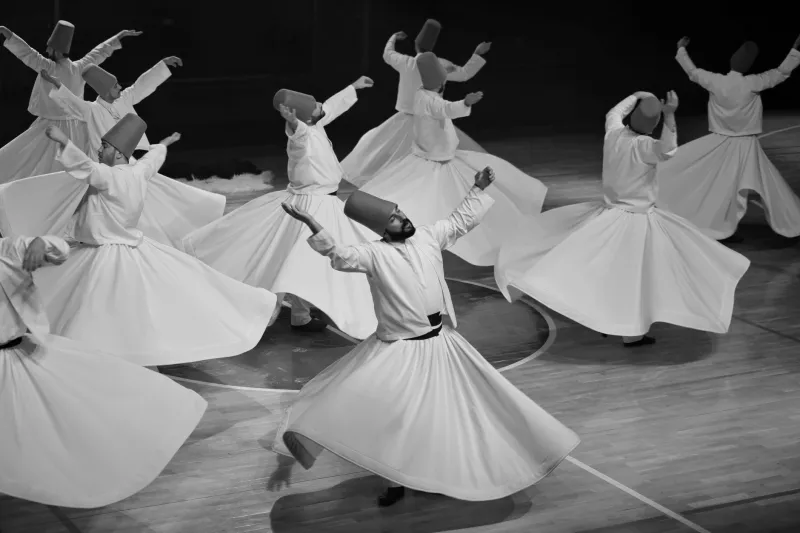
Somewhere between a guided breathing exercise and a notification from a mindfulness app, a twenty-two-year-old in Portland reads a verse attributed to Jalal ad-Din Rumi. She screenshots it, adds a soft amber filter, and posts it to her story. Her caption reads: good vibes only. She has never heard of the Masnavi. She does not know that Rumi wrote in Persian, that he was a thirteenth-century Islamic scholar, or that the line she shared was likely paraphrased — or entirely invented — by a Western publisher in the 1990s.
This is not an unusual story. Across the United States, Sufi mystical poetry has quietly become one of the most consumed literary traditions among younger audiences, not through university syllabi or literary journals, but through wellness culture, spiritual TikTok, and meditation communities that have embraced its imagery of longing, union, and divine love. Rumi, Hafiz, and Ibn Arabi are now household names in certain corners of American spirituality — yet the Islamic theological tradition that produced them is frequently invisible, or actively erased.
The Algorithm as Spiritual Guide
The path from classical Arabic and Persian verse to a Gen Z For You Page is shorter than it might seem. Wellness content creators discovered years ago that Sufi-adjacent language — the soul's longing, the beloved, the tavern of light — translates seamlessly into the vocabulary of self-care and personal growth. Accounts with hundreds of thousands of followers regularly post attributed or misattributed lines from Rumi alongside sunrise photography, and the engagement numbers suggest an enormous appetite.
Dr. Leila Mansouri, a scholar of Islamic mysticism at a mid-Atlantic research university who has studied this phenomenon for several years, describes the dynamic with measured concern. "There is something genuinely moving about young people seeking depth in a fragmented media environment," she says. "But when Rumi is presented as a universal life coach rather than a Muslim mystic writing within a specific theological tradition, something essential disappears. The longing in his poetry is not generic longing — it is longing for God, understood through a very particular Islamic framework."
For Arab-American Gen Z audiences, the picture is more complicated still. Many young Arab-Americans are encountering Rumi or Hafiz through the same wellness channels as their non-Arab peers, occasionally unaware that these figures belong, at least partially, to a broader cultural inheritance their own families carry. The irony is not lost on scholars or poets who work within this tradition.
What Gets Lost, and What Surprisingly Survives
The question of what is preserved and what is discarded in this cultural translation is not simple. Critics of the wellness-Rumi phenomenon rightly point to the erasure of Islamic context, the commercial sanitization of verse that was originally devotional and theologically precise, and the long history of Western publishers — most famously Coleman Barks, whose Rumi translations became bestsellers — deliberately removing Islamic references to make the poetry more palatable to American readers.
Yet scholars like Dr. Mansouri are careful not to dismiss every contemporary engagement with Sufi poetry as appropriation. "There are young Arab-Americans and Muslim converts who begin with a screenshot on Instagram and end up reading actual translations, studying Arabic, attending dhikr circles," she notes. "The algorithm sometimes opens a door. The question is whether there is something meaningful on the other side of it."
Nadia Al-Rashid, a twenty-six-year-old Palestinian-American poet based in Chicago who writes in both Arabic and English, describes her own complicated relationship with the Sufi revival. She first encountered Ibn Arabi not through her family — secular in orientation — but through a college seminar on world literature. "I felt this strange pride and this strange grief at the same time," she says. "Pride that this tradition existed, grief that I had to discover it in an American classroom rather than growing up with it. And then I look online and I see his name attached to quotes that have nothing to do with him, and I feel something else entirely."
Al-Rashid's own poetry draws deliberately on Sufi imagery — the moth and the flame, the reed's cry for the reed bed — while grounding those images in explicitly contemporary Arab experience. She describes this as a form of reclamation, not nostalgia. "I am not trying to recreate the thirteenth century," she says. "I am trying to show that this tradition is alive and that it belongs to us."
The Theology Behind the Aesthetic
For those willing to look past the Instagram captions, the actual theological and literary depth of the Sufi tradition is staggering. Ibn Arabi, born in Andalusia in 1165 and writing in classical Arabic, produced a body of mystical philosophy — most famously the Fusus al-Hikam and the Futuhat al-Makkiyya — that engaged with questions of divine unity, the nature of the self, and the relationship between creation and the divine in ways that continue to challenge readers today. His poetry collection Tarjuman al-Ashwaq, ostensibly a love poem cycle, is simultaneously a dense theological text requiring commentary to fully understand.
Hafiz, writing in fourteenth-century Persia, used the imagery of wine, the tavern, and the beloved in ways that operated on multiple levels simultaneously — the literal, the romantic, and the mystical — a technique known in Sufi literary tradition as zāhir and bātin, the outer and inner meanings. To read Hafiz as only a poet of earthly love is to read half a text.
These layers are rarely communicated in wellness contexts. And yet, as Dr. Mansouri points out, the desire that draws young Americans to this poetry in the first place — the hunger for transcendence, for beauty that carries weight, for language that takes the interior life seriously — is not entirely disconnected from what the original poets were addressing. "The longing is real," she says. "The question is whether we honor it by giving people the full tradition, or whether we keep serving them beautiful fragments."
Toward a More Honest Revival
For Arab-American communities and diaspora cultural institutions, the Sufi poetry moment presents both a challenge and an opening. The challenge is obvious: a tradition deeply rooted in Islamic theology and Arabic literary culture is being consumed at scale in forms that obscure both. The opening is equally real: there has perhaps never been a moment when more young Americans were willing to sit with the language of mysticism, longing, and spiritual depth.
Poets, scholars, and cultural organizations working in this space are increasingly deliberate about providing context alongside the verse — not to police access, but to honor the full weight of what is being offered. Al-Shaer believes that Arabic poetry, in all its complexity, deserves to be encountered whole.
Nadia Al-Rashid puts it simply: "If a line from Rumi or Ibn Arabi moves you, that feeling is real. But don't stop there. Follow it. Learn where it came from. You might find that the full tradition is even more beautiful than the caption."
The mystics wrote for seekers. The least we can do is seek honestly.